
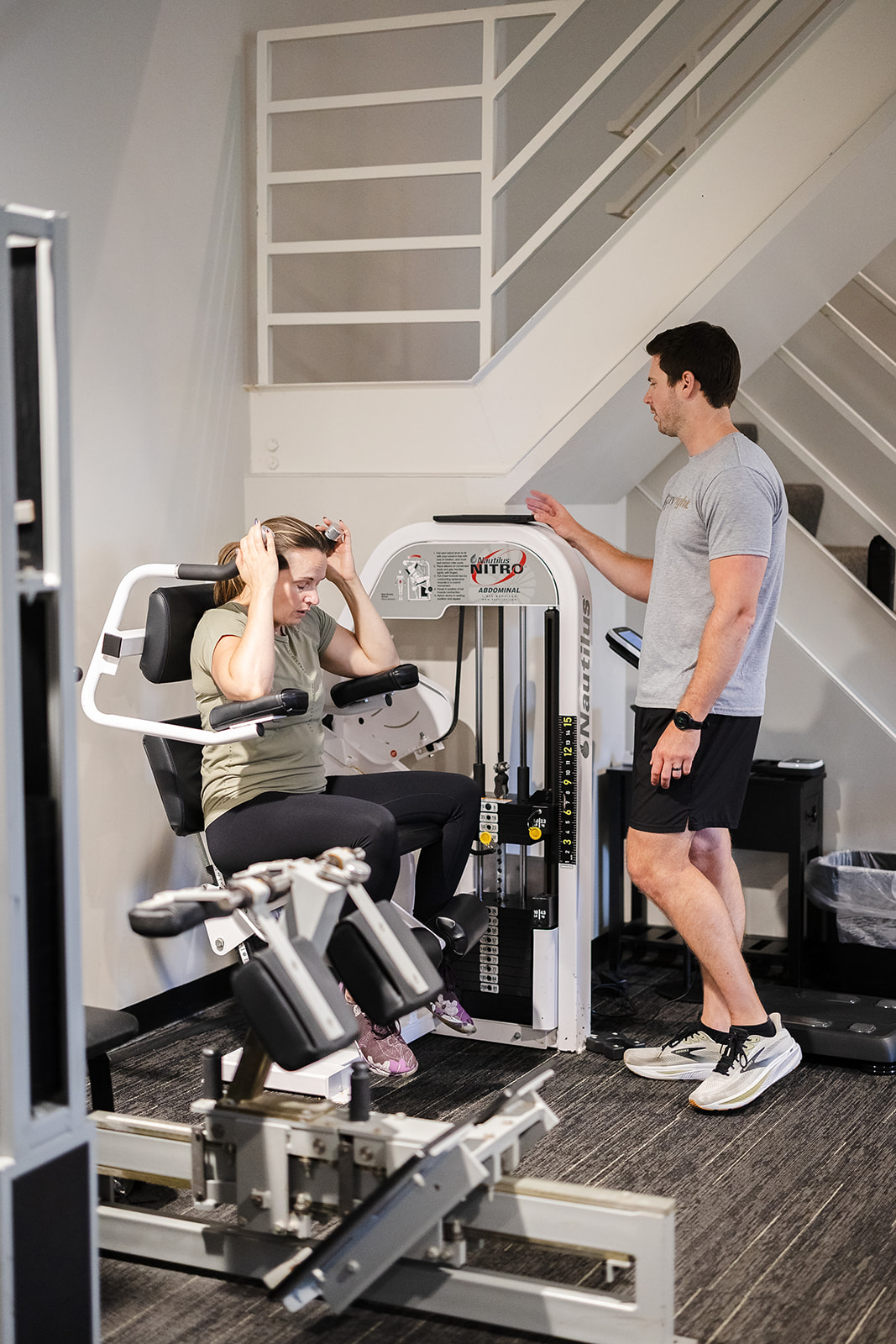
Core training is still one of the hottest trend in the fitness industry today. Practitioners ranging from personal trainers to strength coaches to sports medicine physicians espouse the importance of “core” training for individuals varying from professional athletes to sedentary persons.
Despite the popularity of “core” training, the term “core” cannot be found in a human anatomy or physiology textbook. The reason: an apple has a core, a human does not. In order to plan and perform effective “core” training, one must first examine the muscles or muscle groups that comprise what is commonly referred to as the “core.”
“Core” is a term that is used to describe the muscles of the midsection including the Trunk Flexors (Rectus Abdominus), Extensors (Erector Spinae group), and Rotators (External and Internal Abdominal Oblique). The importance of training these muscle groups is not a new concept. These muscle groups act collectively to flex, rotate, and extend the spine. As does almost every muscle in the body in some fashion, these muscles serve as stabilizers as well. These muscles need not be trained differently than any other muscle or muscle group. That is, using a system of progression, place tension/resistance on these muscles through a full range of motion thus leading to fatigue. Balls, balancing exercises and other commercially hyped products do not more effectively target these muscles and need not be utilized in order to achieve optimal results.
In addition, these muscles and the exercises used to target them are not more important than any other exercises or muscle groups. A mystique exists that strength in these muscles is the key to athletic performance. In truth, athletic performance requires a synergistic effort of essentially all muscle structures, thus all should be trained with equal emphasis.
Mistakenly, the vast majority of people judge the strength of their midsection muscles by how they look in the mirror. This is a flawed evaluation. Why? Simply put, unless an individual has a relatively low percentage of body fat, abdominal and other midsection muscles will not be visible. Doing more “core” exercises will not improve the appearance of one’s midsection nor will it rid fat from this area. The truth is that with a low enough body fat percentage, almost all people have the abdominal muscle to have a lean, attractive, “six-pack” appearance. In almost all cases… midsection “attractiveness” is not a matter of not enough muscle but instead, an issue of too much fat.

Every new client receives a Free Introductory Session.
